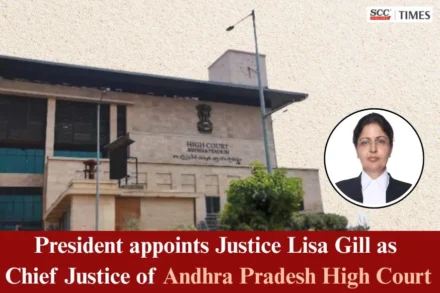
President appoints Justice Lisa Gill as Chief Justice of Andhra Pradesh High Court
Justice Lisa Gill was transferred from Punjab and Haryana High Court to Andhra Pradesh High Court on 6 March 2026.
Continue reading
Justice Lisa Gill was transferred from Punjab and Haryana High Court to Andhra Pradesh High Court on 6 March 2026.
Continue reading
The Court explained that the functioning of the High-Powered Committee is still at a nascent stage and therefore, the incorporation of this additional mandate, being of utmost significance, would not burden its proceedings.
Continue reading
It was further held that the courts must identify and determine “points for determination”, even in default or ex parte suits, and answer them to resolve the matter of controversy between the parties.
Continue reading
“The Right to Life enshrined under Article 21 of the Constitution is not merely a guarantee against the unlawful taking of life, but a positive mandate upon the State to ensure a safe environment where human life is preserved and valued.”
Continue reading
“Protection of natural resources and fragile ecosystems is not only a statutory obligation but a constitutional imperative.”
Continue reading
Upholding NCDRC’s decision holding Canara Bank liable for delayed presentation of cheques, Supreme Court explained that a bank acts as a customer’s agent and is under an obligation to exercise due diligence in presenting the instruments within the prescribed validity period.
Continue reading
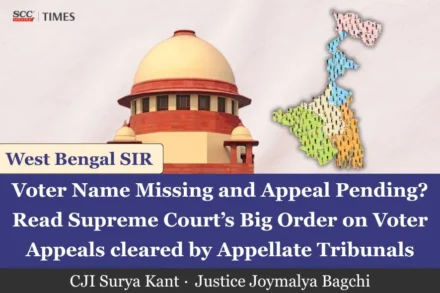
As West Bengal goes for election on 23 and 29 April 2026, the Supreme Court on 13 April 2026 issued specific directions to Election Commission of India for cases where voter appeals have been decided by 21 April 2026 or 27 April 2026.
Continue reading
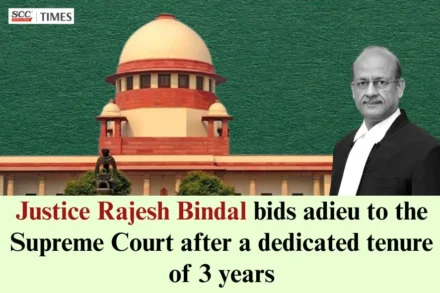
Prior to being elevated to the Supreme Court in 2023, Justice Rajesh Bindal served as the Chief Justice of Allahabad High Court.
Continue reading
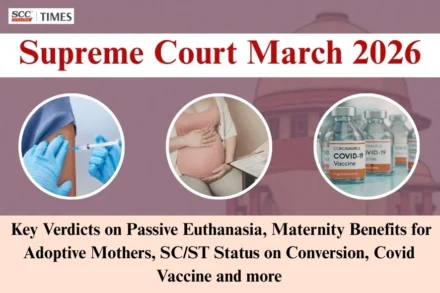
Stay informed with the latest Supreme Court judgments from March 2026, covering historical verdict on Passive Euthanasia, upholding Maternity Benefits for Adoptive Mothers, SC/ST status on conversion, Covid Vaccine deaths, alleged copyright infringement by Sujoy Ghosh’s Kahaani-2, Systemic discrimination against women in Armed Forces and many more.
Continue reading
In a meeting held on 24 March 2026, CJI Surya Kant led Collegium recommended the names of 8 Additional Judges to be appointed as Permanent Judges.
Continue reading
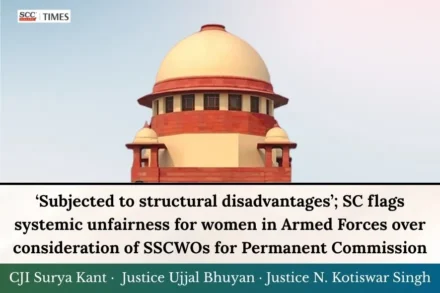
“Denial of PC to SSCWOs was not merely the outcome of individual assessments, but the consequence of a systemic framework rooted in assumptions that entrenched disadvantages in career progression”.
Continue reading
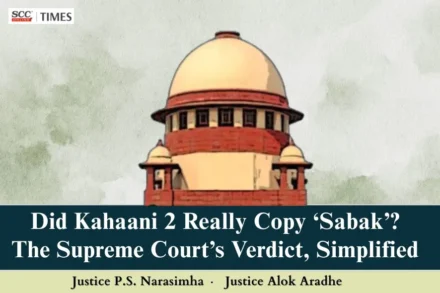
A sequel to award-winning film “Kahaani”, Sujoy Ghosh’s “Kahaani 2” was embroiled in controversy when in 2016, it was alleged that the film had infringed copyright of the complainant’s script titled “Sabak”.
Continue reading
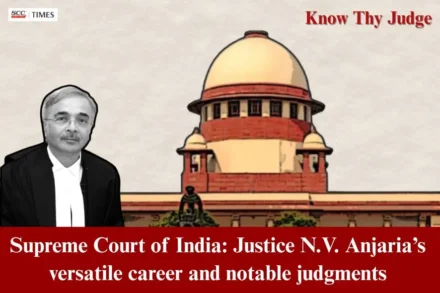
Justice Nilay Vipinchandra Anjaria was serving as the 34th Chief Justice of Karnataka High Court prior to being appointed as Judge of Supreme Court in May 2025.
Continue reading
The decision was taken at a Full Court meeting held on 18 March 2026 by the Chief Justice of India and Supreme Court Judges.
Continue reading
The Circuit Court had granted the divorce decree on the ground of irretrievable breakdown of marriage, which is not a recognised ground under Hindu Marriage Act, 1955 (HMA). However, taking note that the parties have been separated for 18 years, Supreme Court exercising its Art. 142 powers, decided to dissolve the marriage.
Continue reading
The Court grimly noted that hooliganism shown by the members of Barabanki Bar Association, stating that Bar Council of India is expected to take appropriate action. The Court also transferred the case to Tis Hazari Courts to ensure fair trial.
Continue reading
Section 60(4), Social Security Code, 2020 which entitled maternity benefit of 12 weeks to mothers who legally adopt a child below the age of 3 months, was held to be violative of the Constitution.
Continue reading
In a landmark verdict, the Supreme Court of India permitted withdrawal of life-sustaining treatment for a patient who had been in a Persistent Vegetative State (PVS) for 13 years, while clarifying guidelines laid down in Common Cause v. Union of India, (2018) 5 SCC 1 and urging the Centre to fill the legislative gaps on subject of end-of-life care.
Continue reading
In a historic ruling, the Supreme Court of India permitted withdrawal of life-sustaining treatment for a patient who had been in a Persistent Vegetative State (PVS) for 13 years, reaffirming the constitutional principle of the right to die with dignity and clarifying the application of the Common Cause euthanasia guidelines across India.
Continue reading
Acknowledging that right to die with dignity is inseparable from the right to receive quality palliative care, Supreme Court for the first time allowed passive euthanasia by withdrawal of the applicant’s Clinically Assisted Nutrition and Hydration.
Continue reading