2026 SCC Vol. 8 Part 3: Supreme Court rulings on river pollution, mental cruelty, autism and more
Three rulings in SCC Vol. 8 Part 3 cover river pollution, divorce, and stem cell therapy.

Bringing you the Best Analytical Legal News


Three rulings in SCC Vol. 8 Part 3 cover river pollution, divorce, and stem cell therapy.
Eight rulings in SCC Vol. 8 Part 2 cover grounds of arrest, deficiency in bank service, contempt and cheque bounce.
Eight Supreme Court rulings on prisons, environmental clearance, operational creditors, police custody, POCSO, POSH and more. This volume of the Supreme Court Cases (SCC), Part 1 of Volume 8, carries key cases decided by the Supreme Court on issues such as constitutional distribution of powers, prior environment clearance, enforcement of claims by operational creditors, grant of police custody, and more.
The Court approved Amicus’s 11 condition framework for disposal of minerals from expired leases, holding the conditions mandatory, and permitted amalgamation of mining blocks with virgin forest land for auction, subject to strict statutory and environmental safeguards..
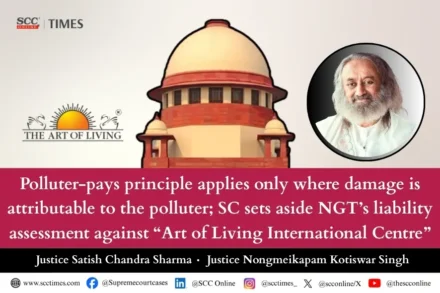
The Court held that the mere existence of environmental degradation is insufficient. A causal connection between the conduct of the alleged polluter and the environmental damage must be established.
From a fake AI-generated precedent that voided an insolvency order to a stray bull attack that reshaped animal-welfare law, July 2026 was one of the Supreme Court’s most consequential months. Explore 30+ rulings spanning constitutional law, criminal justice, technology, and human rights, plus the appointments, transfers, and numbers behind the month’s docket.

Justice M.M. Sundresh’s journey from a small town to the highest echelons of the Indian judiciary serves as an inspiration to many aspiring legal minds.

Explore the latest Supreme Court Cases in 2026 SCC Vol. 5 Part 2 on investigation, environmental impact assessment, mortgage by conditional sale, and more.

“We have considered the proposal submitted by the CAQM and find the same to be reasonable, just, and fair.”
Explore the latest Supreme Court Cases in 2026 SCC Vol. 2 Part 5 on arbitrability of dispute, Polluter Pays Principle, Registration of documents, detention and seizure of goods, and more.
Explore the latest Supreme Court Cases in 2026 SCC Vol. 2 Part 2 on vesting of private forests, road safety, professional communication, and Aravalli Hills & Ranges.

“No other option is left with us but to summon all the State authorities who are impleaded herein, as it appears that, in such an important matter involving public interest, they are not only not cooperating, but their conduct displays certain intransigence which needs to be addressed.”
In the flood plains, people cannot be allowed to make their houses, tenements, sheds, etc., under the pretext of graveyard or for any other purpose.

2025 SCC Vol. 10 Part 2: Explore the latest Supreme Court Cases on Arbitration, Constitution, CPC, Consumer Protection, Education Law, Environment Law, Motor Vehicles Act, and more.

During the course of suo motu action on illegal constructions and rampant felling of trees in the Corbett Tiger Reserve, the Supreme Court granted an order of sanction vis-a-vis an officer, who then went on to challenge it before Uttaranchal High Court and obtained a stay.

“Time has come that all stakeholders must contemplate about creating Corporate Climate Responsibility Fund which may be dedicated to address the problems relating to environment/cleanliness/public hygiene.”

The Court noted that undisputedly, the residue from the incineration process was also toxic and needed to be contained for almost 30-40 years.

Born on 21-07-1962, in the picturesque city of Erode, Justice M.M. Sundresh’s remarkable legal career, led to his appointment as a Judge of the Supreme Court of India on 26-08-2021. His journey from a small town to the highest echelons of the Indian judiciary serves as an inspiration to many aspiring legal minds.

The Court stated that the Water and Air Rules empowered the State to appoint a single- or three-member body as the Appellate Authority. Thus, if the State, vide the impugned notifications, opted for a single-member Appellate Authority, then the power exercised by the State was within the four corners of the said enactments.

“To permit nearly four decades to elapse without any discernible, substantive action flowing from a statutory declaration is, to put it mildly, an affront to the principles of effective governance and a manifest failure at the end of concerned officers, both statutory and constitutional.”